
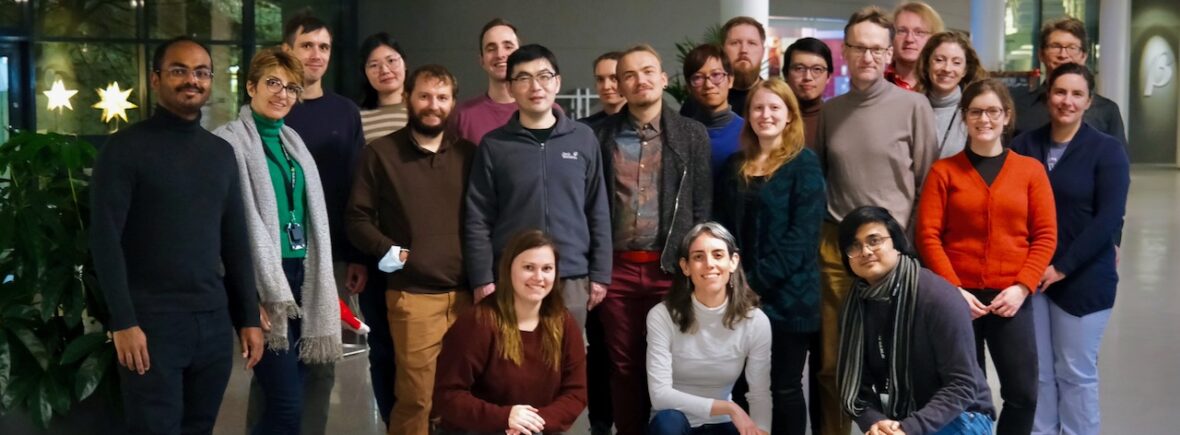
Research Team
Led by Professor Erik Lindahl and Dr Reba Howard, the Molecular Biophysics Research Team combines structural, functional, and computational approaches to characterize complex biomolecules. Members are engaged at various levels in connecting insights between experimental biochemistry data and molecular dynamics simulations. Historically, the team has focused on applications to the rich allostery and pharmaceutical potential of ligand-gated ion channels.
Postdoctoral Positions
The Molecular Biophysics Research Team is currently considering sponsorship of applicants to the following postdoctoral programs:
- SciLifeLab Program for Future Leaders in Life Science (PULSE), a comprehensive Marie Skłodowska-Curie Actions (MSCA) Cofund postdoctoral program, due 16 March 2026
- SciLifeLab and Wallenberg National Research School Postdoctoral Program for Data-Driven Life Science (DDLS), due 31 March 2026
Pending outcomes from the above programs, we also anticipate opening a postdoctoral trainee call later this year in the Molecular Biophysics Research Team. For more information, check the Stockholm University or KTH Royal Institute of Technology websites. We are always interested in hearing from motivated applicants about the possibility of developing a project or grant proposal; contact join-mbp@scilifelab.se or a relevant group or team lead for more information.
Doctoral Positions
The Molecular Biophysics Research Team anticipates opening a doctoral student call later this year. For more information, check the Stockholm University employment site. We are always interested in hearing from motivated applicants about the possibility of developing a project or grant proposal; contact join-mbp@scilifelab.se or a relevant group or team lead for more information.
Master’s/Bachelor’s Research Projects
Four types of research projects, intended for the master’s or bachelor’s levels, are anticipated in coming terms in the following areas:
Cryogenic electron microscopy (cryo-EM) of membrane proteins
Optimize sample preparation, data collection, and image analysis to elucidate the atomic structure of technically challenging macromolecules, focusing on biochemistry or software methods.
Electrophysiology of novel receptor variants
Express and characterize ion-channel proteins in heterologous cells, using molecular biology and voltage-clamp recordings to elucidate molecular mechanisms and pharmacology.
Simulating ion-channel gating and modulation
Harness structure-function data to simulate and analyze modeled ion channels, using molecular dynamics to probe structural changes, drug binding, and disruptive mutations.
AI approaches to enhance biomolecular modeling
Develop and implement machine-learning based analyses to integrate various data types in characterizing structure and dynamics of proteins and other biomolecular complexes.
Applicants should have some theoretical and/or laboratory preparation in biophysics, biochemistry, or related fields, and an enthusiasm for interdisciplinary research and communication. Regrettably, we cannot currently support stipends or employment of research assistants or paid interns for predoctoral projects. Please contact join-mbp@scilifelab.se or a relevant group or team lead for more information.
Software Team
Led by Professor Erik Lindahl, the Molecular Biophysics Software Team is the central development site for the widely used molecular dynamics package GROMACS. Announcements of Open Positions are available on the GROMACS community forum. We are always interested in hearing from motivated applicants about the possibility of developing a project or grant proposal; contact join-mbp@scilifelab.se or a relevant group or team lead for more information.