
Publications

Gating for Cognition

Published 15 June in Nature Communications (doi 10.1038/s41467-026-74279-3):

Structural basis for activation and potentiation in a human α5β3 GABA(A) receptor

John CowgillChen Fan, Jan Steyaert, Rebecca J Howard,° Erik Lindahl°

Anesthetics and anticonvulsants act, in part, through diverse populations of type-A ɣ-aminobutyric acid receptors (GABAARs) formed from a pool of 19 subunits. In the hippocampus, α5 subunits primarily coassemble with β3 and, in some cases, γ2, generating numerous subtypes with differential functional and pharmacological properties critical in learning and memory. The stoichiometry, structure, and gating of these subpopulations are poorly understood. Here we show using cryogenic electron microscopy and electrophysiology that the human α5β3 GABAAR predominantly assembles with 2α:3β stoichiometry, though a minority population of 1α:4β indicates multiple assemblies are possible. In a resting-like state, a conserved activation gate and Zn2+-coordination at histidines on β3 block ion conduction. Upon GABA binding, global rearrangements release Zn2+ and open the activation gate in nearly all receptors. The activated receptor is unaffected upon binding the anesthetic etomidate or anticonvulsant topiramate, supporting a conformational selection mechanism of action. This work thus reveals the assembly, activation, and modulation of a GABAAR subtype critical to cognition, providing templates for structure-based drug discovery.

°Co-corresponding authors

Read the full publication here.

Publications

Sex Steroids in Suckers

Published 2 April 2026 in Science (doi 10.1126/science.aec9652):

A sensory system for mating in octopus

Pablo S Villar,* Hao Jiang,* Tatiana Shugaeva, Emma L Berdan, Arpita Kulkarni, Makoto Hiroi, Giovanni Masucci, Sam Reiter, Erik Lindahl, Rebecca J Howard, Ryan E Hibbs, Nicholas W Bellono

Sensory systems for mate recognition maintain species boundaries and influence diversification. Thus, uncovering how molecules and receptors evolve to mediate this critical function is essential to understanding biodiversity. Male octopuses use a specialized arm called the hectocotylus to identify females and navigate their internal organs to reach the oviduct and deliver sperm. Here, we discovered that the hectocotylus is a dual sensory and mating organ that uses contact-dependent chemosensation of progesterone, a conserved ovarian hormone. We identified chemotactile receptors for progesterone and resolved the structural basis for their evolution from ancestral neurotransmitter receptors and subsequent expansion and tuning across cephalopods. These findings reveal principles by which sensory innovations shape reproductive behavior and suggest mechanisms for how sensory evolution contributes to the diversification of life.

*Equal contributions

Read the full publication here.

Publications

Calcium Lockdown

Published 12 November 2025 in Journal of Structural Biology X (doi 10.1016/j.yjsbx.2025.100139):

Calcium stabilizes the flexible N-terminal domain of the bacterial ion channel DeCLIC

Chen Fan,° Marie LycksellYuxuan ZhuangRebecca J Howard,° Erik Lindahl°

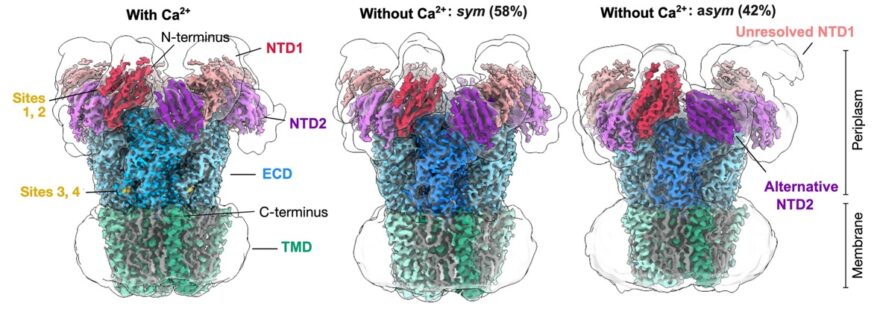
Pentameric ligand-gated ion channels (pLGICs) are responsible for the rapid conversion of chemical to electrical signals. In addition to the canonical extracellular and transmembrane domains, some prokaryotic pLGICs contain an N-terminal domain (NTD) of unclear structure and function. In one such case, the calcium-sensitive channel DeCLIC, the NTD appears to accelerate gating; however, its evident flexibility has posed a challenge to model building, and its role in calcium sensitivity is unclear. Here we report cryo-EM structures of DeCLIC in circularized lipid nanodiscs, achieving the highest resolution reported so far, and enabling definition of calcium-binding sites in both the N-terminal and canonical extracellular domains. In addition to the symmetric state, calcium depletion promoted an asymmetric conformation of the NTD, offering a structural rationale for small-angle scattering results. Behavior of these structures in molecular dynamics simulations demonstrated calcium stabilization of the NTD. These features of DeCLIC offer a model system for ion-channel modulation by a flexible accessory domain, potentially conserved in structurally homologous systems across evolution.

°Co-corresponding authors

Read the full publication here.