Publications

Who Dances With an Electric Beat?

For the October 1, 2018 issue of the Journal of General Physiology (v. 150 art. 1444):

Determining the molecular basis of voltage sensitivity in membrane proteins

Marina A. Kasimova, Erik Lindahl & Lucie Delemotte

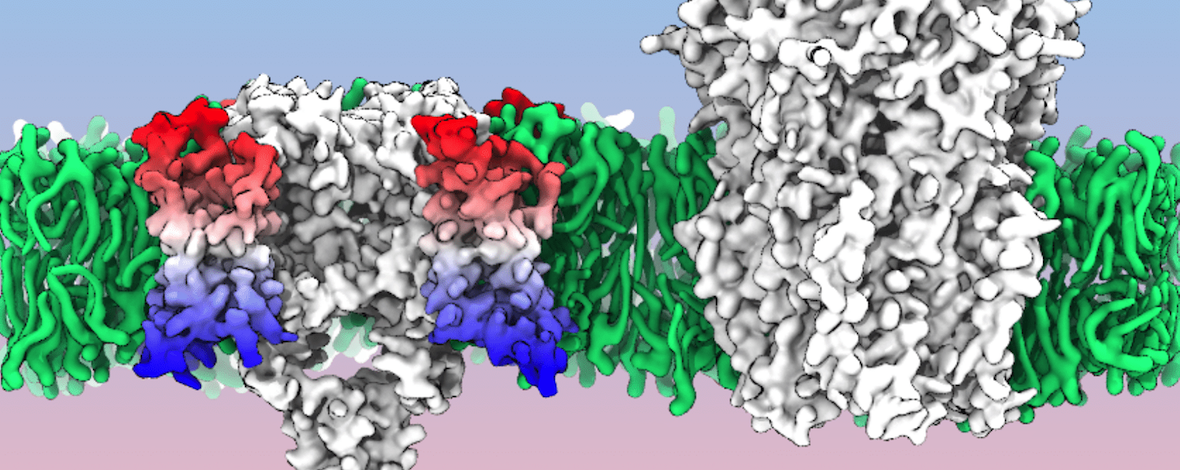
Voltage-sensitive membrane proteins are united by their ability to transform changes in membrane potential into mechanical work. They are responsible for a spectrum of physiological processes in living organisms, including electrical signaling and cell-cycle progression. Although the mechanism of voltage-sensing has been well characterized for some membrane proteins, including voltage-gated ion channels, even the location of the voltage-sensing elements remains unknown for others. Moreover, the detection of these elements by using experimental techniques is challenging because of the diversity of membrane proteins. Here, we provide a computational approach to predict voltage-sensing elements in any membrane protein, independent of its structure or function. It relies on an estimation of the propensity of a protein to respond to changes in membrane potential. We first show that this property correlates well with voltage sensitivity by applying our approach to a set of voltage-sensitive and voltage-insensitive membrane proteins. We further show that it correctly identifies authentic voltage-sensitive residues in the voltage-sensor domain of voltage-gated ion channels. Finally, we investigate six membrane proteins for which the voltage-sensing elements have not yet been characterized and identify residues and ions that might be involved in the response to voltage. The suggested approach is fast and simple and enables a characterization of voltage sensitivity that goes beyond mere identification of charges. We anticipate that its application before mutagenesis experiments will significantly reduce the number of potential voltage-sensitive elements to be tested.

Read the commentary in the same issue by Caitlin Sedwick, or see the paper here!
Publications

Frozen in Motion

From the June 1, 2018 release of eLife (v. 7 art. e36861):

Characterisation of molecular motions in cryo-EM single-particle data by multi-body refinement in RELION

Takanori Nakane, Dari Kimanius, Erik Lindahl & Sjors HW Scheres

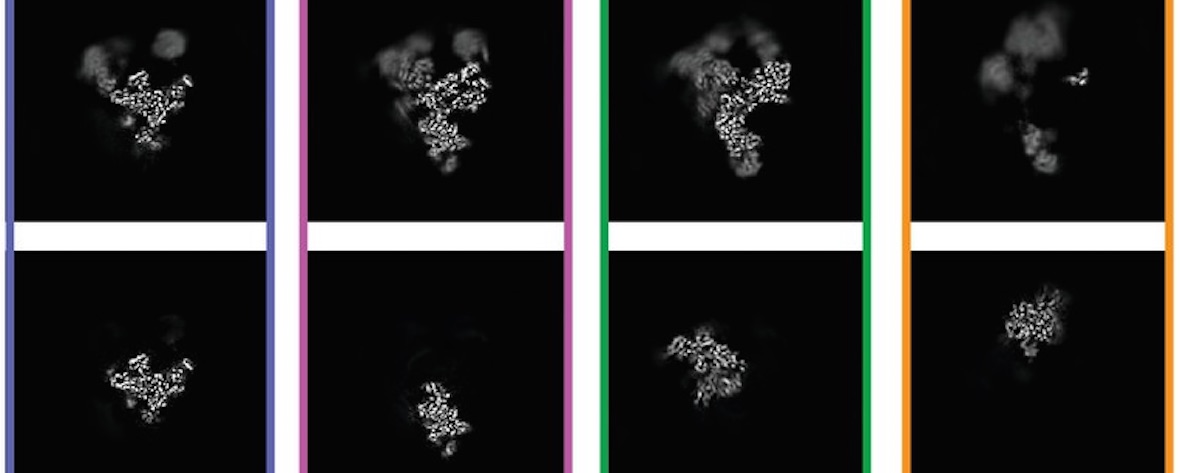
Macromolecular complexes that exhibit continuous forms of structural flexibility pose a challenge for many existing tools in cryo-EM single-particle analysis. We describe a new tool, called multi-body refinement, which models flexible complexes as a user-defined number of rigid bodies that move independently from each other. Using separate focused refinements with iteratively improved partial signal subtraction, the new tool generates improved reconstructions for each of the defined bodies in a fully automated manner. Moreover, using principal component analysis on the relative orientations of the bodies over all particle images in the data set, we generate movies that describe the most important motions in the data. Our results on two test cases, a cytoplasmic ribosome from Plasmodium falciparum, and the spliceosomal B-complex from yeast, illustrate how multi-body refinement can be useful to gain unique insights into the structure and dynamics of large and flexible macromolecular complexes.

Read the full publication here.

Publications

Consciousness Crystallized

Featured on the April 24, 2018 cover of Cell Reports (v. 23 pp. 993–1004):

Structural basis for a bimodal allosteric mechanism of general anesthetic modulation in pentameric ligand-gated ion channels

Zaineb Fourati*, Rebecca J Howard*, Stephanie A Heusser, Haidai Hu, Reinis R Ruza, Ludovic Sauguet, Erik Lindahl** & Marc Delarue**

*Equal contributions; **senior authors

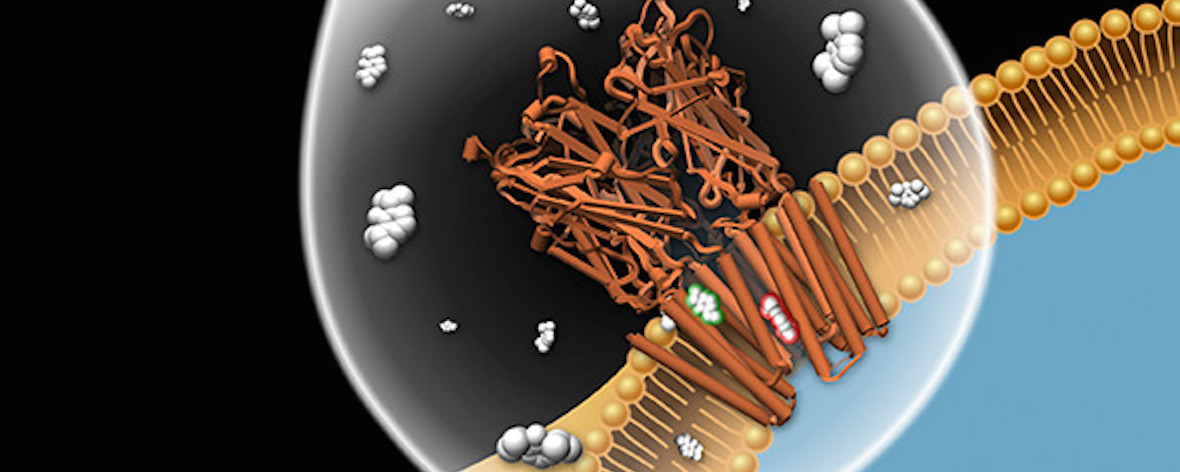
Ion channel modulation by general anesthetics is a vital pharmacological process with implications for receptor biophysics and drug development. Functional studies have implicated conserved sites of both potentiation and inhibition in pentameric ligand-gated ion channels, but a detailed structural mechanism for these bimodal effects is lacking. The prokaryotic model protein GLIC recapitulates anesthetic modulation of human ion channels, and it is accessible to structure determination in both apparent open and closed states. Here, we report ten X-ray structures and electrophysiological characterization of GLIC variants in the presence and absence of general anesthetics, including the surgical agent propofol. We show that general anesthetics can allosterically favor closed channels by binding in the pore or favor open channels via various subsites in the transmembrane domain. Our results support an integrated, multi-site mechanism for allosteric modulation, and they provide atomic details of both potentiation and inhibition by one of the most common general anesthetics.

Read the full publication here.

Publications

Review: Permeating Disciplines

From the April 2018 release of Biochimica et Biophysica Acta – Biomembranes (v. 1860 pp. 927–942):

Permeating disciplines: Overcoming barriers between molecular simulations and classical structure-function approaches in biological ion transport

Rebecca J Howard, Vincenzo Carnevale, Lucie Delemotte, Ute A Hellmich & Brad S Rothberg

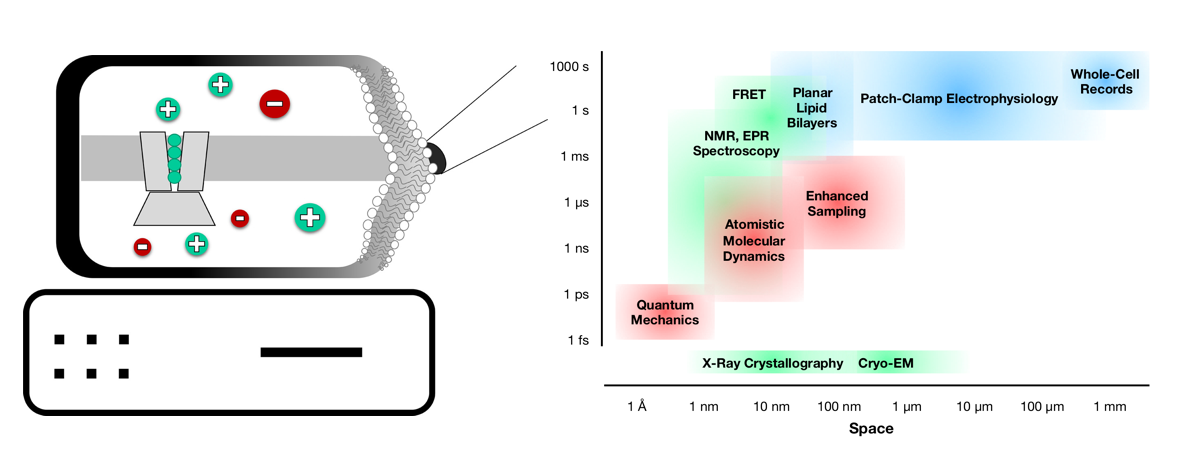
Ion translocation across biological barriers is a fundamental requirement for life. In many cases, controlling this process—for example with neuroactive drugs—demands an understanding of rapid and reversible structural changes in membrane-embedded proteins, including ion channels and transporters. Classical approaches to electrophysiology and structural biology have provided valuable insights into several such proteins over macroscopic, often discontinuous scales of space and time. Integrating these observations into meaningful mechanistic models now relies increasingly on computational methods, particularly molecular dynamics simulations, while surfacing important challenges in data management and conceptual alignment. Here, we seek to provide contemporary context, concrete examples, and a look to the future for bridging disciplinary gaps in biological ion transport. This article is part of a Special Issue entitled: Beyond the Structure-Function Horizon of Membrane Proteins edited by Ute Hellmich, Rupak Doshi and Benjamin McIlwain.

Read the full review article here.