News

Publications

Pi in the Gating Cycle of NavAb

Published 14 December 2022 in Journal of General Physiology (doi 10.1085/jgp.202213214):

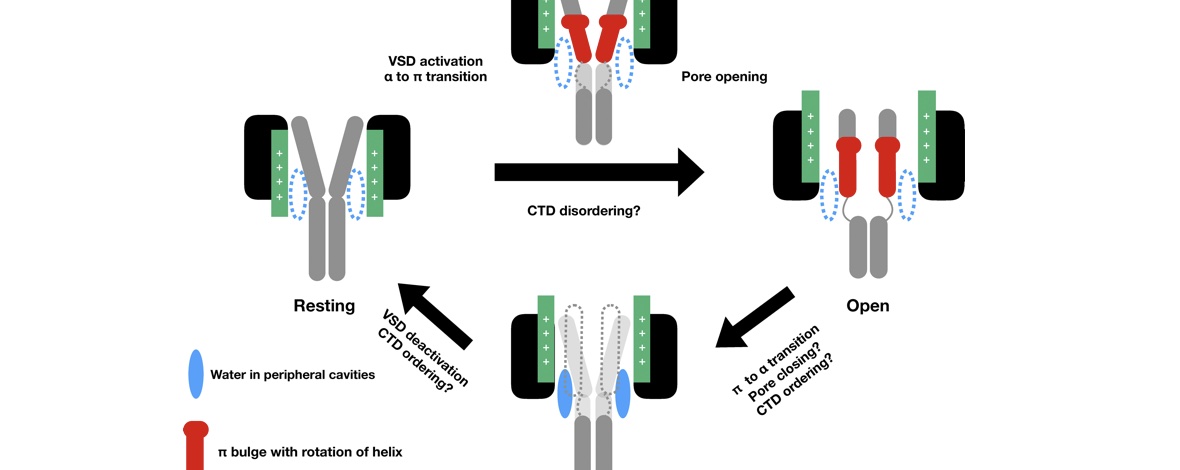
An α–π transition in S6 shapes the conformational cycle of the bacterial sodium channel NavAb

Koushik Choudhury, Rebecca J Howard, Lucie Delemotte

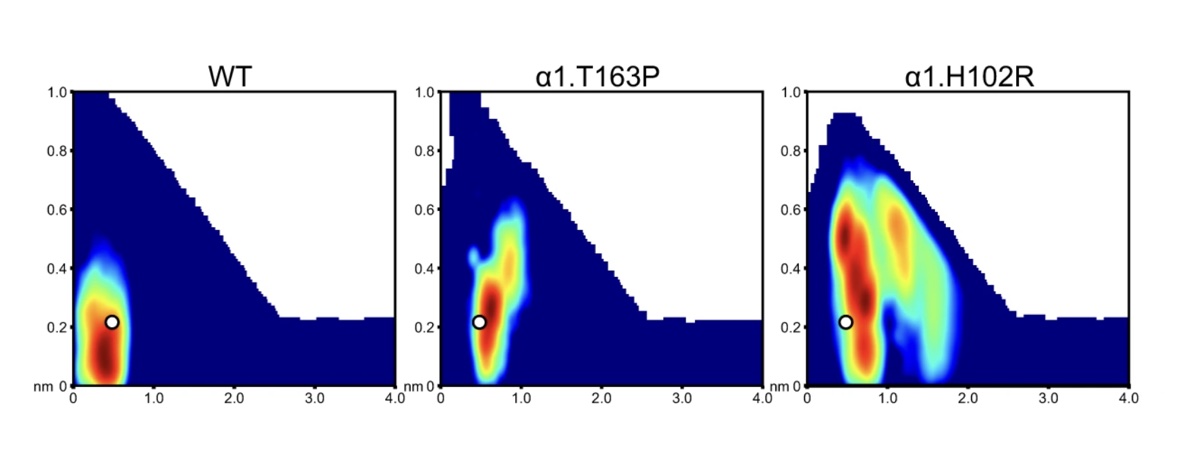
Voltage-gated sodium channels play an important role in electrical signaling in excitable cells. In response to changes in membrane potential, they cycle between nonconducting and conducting conformations. With recent advances in structural biology, structures of sodium channels have been captured in several distinct conformations, which are thought to represent different functional states. However, it has been difficult to capture the intrinsically transient open state. We recently showed that a proposed open state of the bacterial sodium channel NavMs was not conductive and that a conformational change involving a transition to a π-helix in the pore-lining S6 helix converted this structure into a conducting state. However, the relevance of this structural feature in other sodium channels, and its implications for the broader gating cycle, remained unclear. Here, we propose a comparable open state of another class of bacterial channel from Aliarcobacter butzleri (NavAb) with characteristic pore hydration, ion permeation, and drug binding properties. Furthermore, we show that a π-helix transition can lead to pore opening and that such a conformational change blocks fenestrations in the inner helix bundle. We also discover that a region in the C-terminal domain can undergo a disordering transition proposed to be important for pore opening. These results support a role for a π-helix transition in the opening of NavAb, enabling new proposals for the structural annotation and drug modulation mechanisms in this important sodium channel model.

Read the full publication here.
Publications

Divalents and Dynamic Domains

Published 8 December 2022 in Proceedings of the National Academy of Sciences of the USA (doi 10.1073/pnas.2210669119):

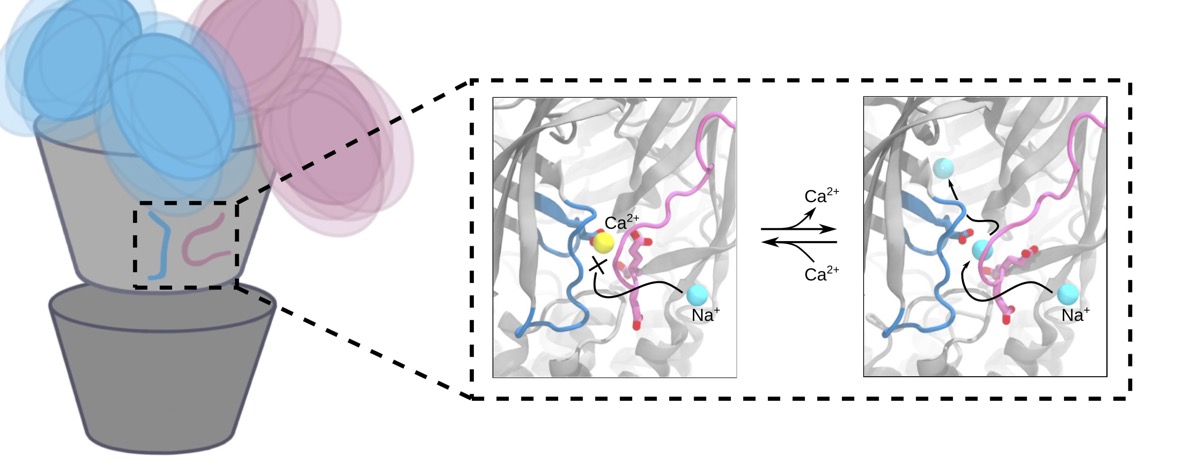
Biophysical characterization of calcium-binding and modulatory-domain dynamics in a pentameric ligand-gated ion channel

Marie Lycksell, Urška Rovšnik, Anton Hanke, Anne Martel, Rebecca J Howard, Erik Lindahl

Pentameric ligand-gated ion channels (pLGICs) perform electrochemical signal transduction in organisms ranging from bacteria to humans. Among the prokaryotic pLGICs, there is architectural diversity involving N-terminal domains (NTDs) not found in eukaryotic relatives, exemplified by the calcium-sensitive channel (DeCLIC) from a Desulfofustis deltaproteobacterium, which has an NTD in addition to the canonical pLGIC structure. Here, we have characterized the structure and dynamics of DeCLIC through cryoelectron microscopy (cryo-EM), small-angle neutron scattering (SANS), and molecular dynamics (MD) simulations. In the presence and absence of calcium, cryo-EM yielded structures with alternative conformations of the calcium-binding site. SANS profiles further revealed conformational diversity at room temperature beyond that observed in static structures, shown through MD to be largely attributable to rigid-body motions of the NTD relative to the protein core, with expanded and asymmetric conformations improving the fit of the SANS data. This work reveals the range of motion available to the DeCLIC NTD and calcium-binding site, expanding the conformational landscape of the pLGIC family. Further, these findings demonstrate the power of combining low-resolution scattering, high-resolution structural, and MD simulation data to elucidate interfacial interactions that are highly conserved in the pLGIC family.

Read the full publication here.
News

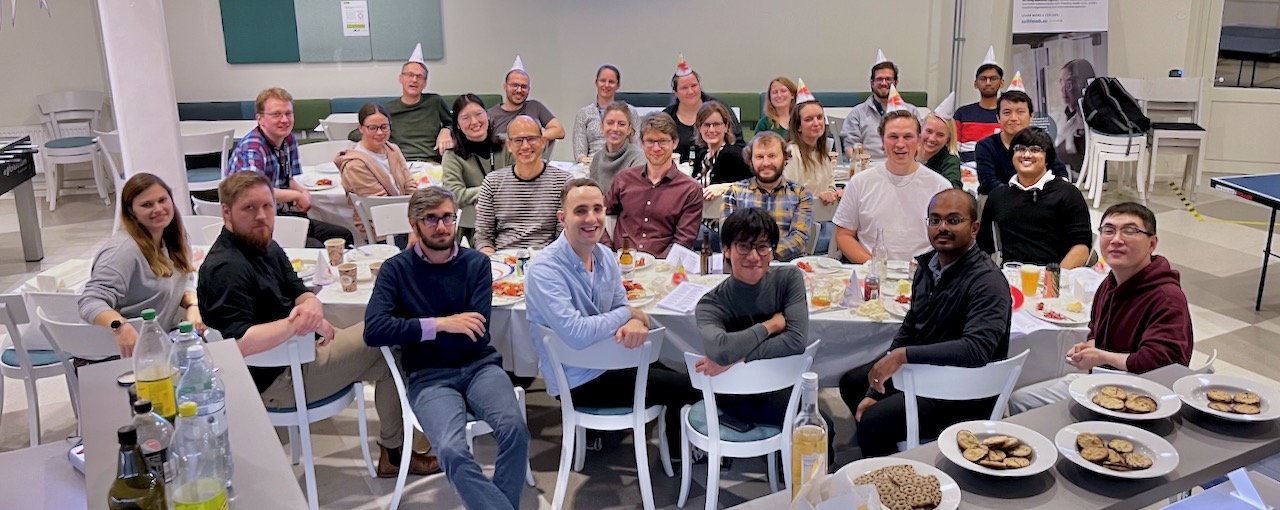
Gott Nytt År

Members of Molecular Biophysics Stockholm helped install seasonal spirit and decor in our SciLifeLab offices on 6 December. Wishing all our members and colleagues a god jul and fine New Year!

News

Grattis till Dr Lycksell

Members of Molecular Biophysics Stockholm joined family and friends in celebrating Marie Lycksell‘s successful spikning and defense of her PhD in Biophysics, Combining low resolution, high resolution, functional, and simulation techniques: In the study of pentameric ligand-gated ion channels. Marie nailed her thesis on 9 November 2022, and defended it 1 December 2022 at Stockholm University, with Professor Kresten Lindorff-Larsen (University of Copenhagen) as opponent. Professor Erik Lindahl and Ligand-Gated Ion Channels team lead Reba Howard led a toast to their advisee of over five years, as she prepares to embark on a postdoctoral fellowship at the Institut Laue-Langevin in Grenoble, France.

Publications

Lipid Sites in nAChR States

Published 17 October 2022 in Proceedings of the National Academy of Sciences of the USA (doi 10.1073/pnas.2208081119):

Differential interactions of resting, activated, and desensitized states of the α7 nicotinic acetylcholine receptor with lipidic modulators

Yuxuan Zhuang, Colleen M Noviello, Ryan E Hibbs, Rebecca J Howard, Erik Lindahl

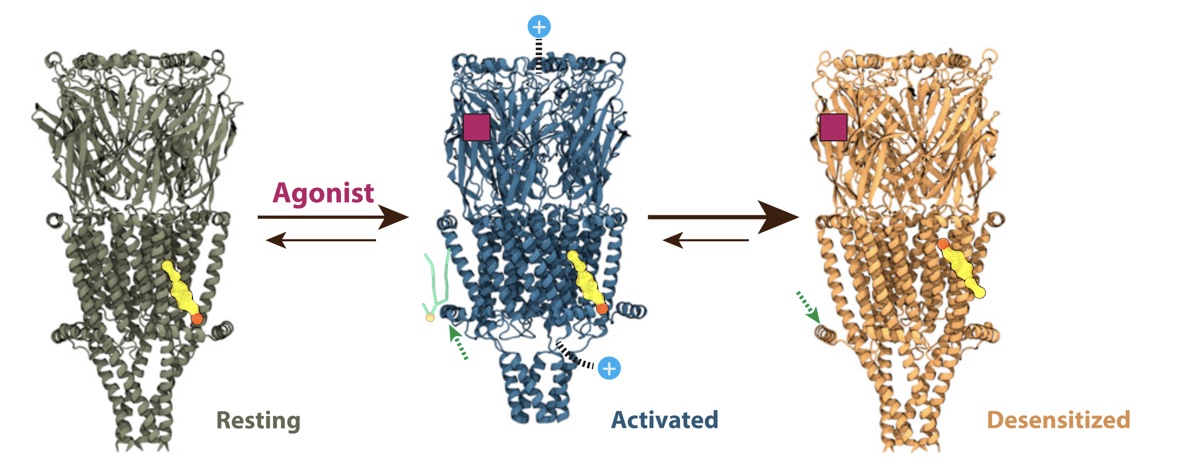
The α7 nicotinic acetylcholine receptor is a pentameric ligand-gated ion channel that modulates neuronal excitability, largely by allowing Ca2+ permeation. Agonist binding promotes transition from a resting state to an activated state, and then rapidly to a desensitized state. Recently, cryogenic electron microscopy (cryo-EM) structures of the human α7 receptor in nanodiscs were reported in multiple conformations. These were selectively stabilized by inhibitory, activating, or potentiating compounds. However, the functional annotation of these structures and their differential interactions with unresolved lipids and ligands remain incomplete. Here, we characterized their ion permeation, membrane interactions, and ligand binding using computational electrophysiology, free-energy calculations, and coarse-grained molecular dynamics. In contrast to nonconductive structures in apparent resting and desensitized states, the structure determined in the presence of the potentiator PNU-120596 was consistent with an activated state permeable to Ca2+. Transition to this state was associated with compression and rearrangement of the membrane, particularly in the vicinity of the peripheral MX helix. An intersubunit transmembrane site was implicated in selective binding of either PNU-120596 in the activated state or cholesterol in the desensitized state. This substantiates functional assignment of all three lipid-embedded α7-receptor structures with ion-permeation simulations. It also proposes testable models of their state-dependent interactions with lipophilic ligands, including a mechanism for allosteric modulation at the transmembrane subunit interface.

Read the full publication here.

News

2022 Fall Retreat

Thirty members of Molecular Biophysics Stockholm finally gathered 25–26 August at Skepparholmen Nacka, our first such off-site group program since 2019. The program included workshops on interdisciplinary communication, popular science, course development, and networking skills, as well as bonding over wonderful meals, pools, and saunas. Big thanks to Alessandra, Anton, Michele, and Reba for co-organizing this long-awaited retreat.

Publications

Modeling Bimodal Modulation

Published 6 August 2022 in Nature Communications (doi 10.1038/s41467-022-32212-4):

Structural and dynamic mechanisms of GABAA receptor modulators with opposing activities

Shaotong Zhu, Akshay Sridhar, Jinfeng Teng, Rebecca J HowardErik Lindahl & Ryan E Hibbs

γ-Aminobutyric acid type A (GABAA) receptors are pentameric ligand-gated ion channels abundant in the central nervous system and are prolific drug targets for treating anxiety, sleep disorders and epilepsy. Diverse small molecules exert a spectrum of effects on γ-aminobutyric acid type A (GABAA) receptors by acting at the classical benzodiazepine site. They can potentiate the response to GABA, attenuate channel activity, or counteract modulation by other ligands. Structural mechanisms underlying the actions of these drugs are not fully understood. Here we present two high-resolution structures of GABAA receptors in complex with zolpidem, a positive allosteric modulator and heavily prescribed hypnotic, and DMCM, a negative allosteric modulator with convulsant and anxiogenic properties. These two drugs share the extracellular benzodiazepine site at the α/γ subunit interface and two transmembrane sites at β/α interfaces. Structural analyses reveal a basis for the subtype selectivity of zolpidem that underlies its clinical success. Molecular dynamics simulations provide insight into how DMCM switches from a negative to a positive modulator as a function of binding site occupancy. Together, these findings expand our understanding of how GABAA receptor allosteric modulators acting through a common site can have diverging activities.

Read the full publication here.

Publications

COVID-E Biophysics

Published 1 October 2022 in Biochimica et Biophysica Acta – Biomembranes (doi 10.1016/j.bbamem.2022.183994):

Probing effects of the SARS-CoV-2 E protein on membrane curvature and intracellular calcium

Aujan Mehregan, Sergio Pérez-Conesa, Yuxuan Zhuang, Ahmad Elbahnsi, Diletta Pasini, Erik Lindahl, Rebecca J Howard, Chris Ulens, Lucie Delemotte

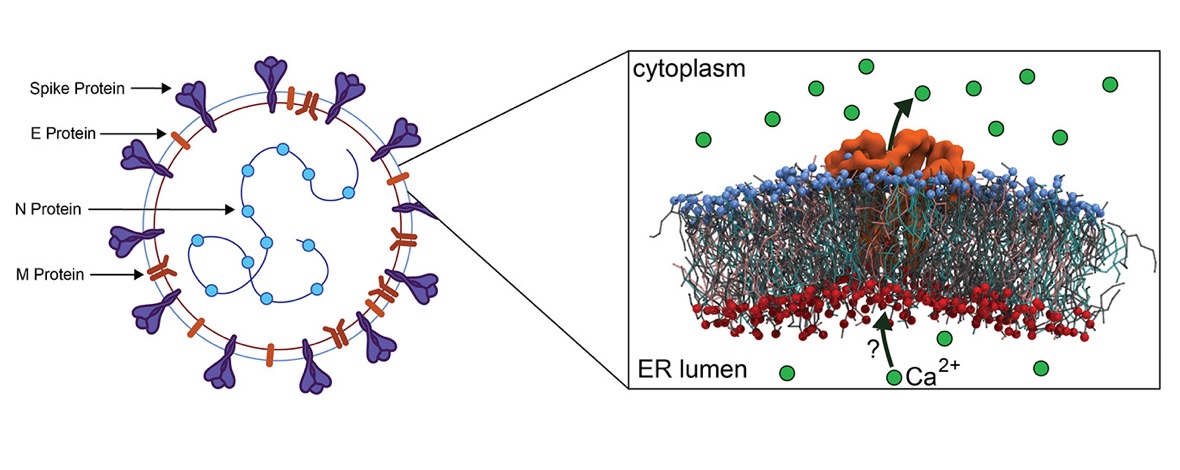
SARS-CoV-2 contains four structural proteins in its genome. These proteins aid in the assembly and budding of new virions at the ER-Golgi intermediate compartment (ERGIC). Current fundamental research efforts largely focus on one of these proteins – the spike (S) protein. Since successful antiviral therapies are likely to target multiple viral components, there is considerable interest in understanding the biophysical role of its other structural proteins, in particular structural membrane proteins. Here, we have focused our efforts on the characterization of the full-length envelope (E) protein from SARS-CoV-2, combining experimental and computational approaches. Recombinant expression of the full-length E protein from SARS-CoV-2 reveals that this membrane protein is capable of independent multimerization, possibly as a tetrameric or smaller species. Fluorescence microscopy shows that the protein localizes intracellularly, and coarse-grained MD simulations indicate it causes bending of the surrounding lipid bilayer, corroborating a potential role for the E protein in viral budding. Although we did not find robust electrophysiological evidence of ion-channel activity, cells transfected with the E protein exhibited reduced intracellular Ca2+, which may further promote viral replication. However, our atomistic MD simulations revealed that previous NMR structures are relatively unstable, and result in models incapable of ion conduction. Our study highlights the importance of using high-resolution structural data obtained from a full-length protein to gain detailed molecular insights, and eventually permitting virtual drug screening.

Read the full publication here.

News

Teens on Virtual Tour

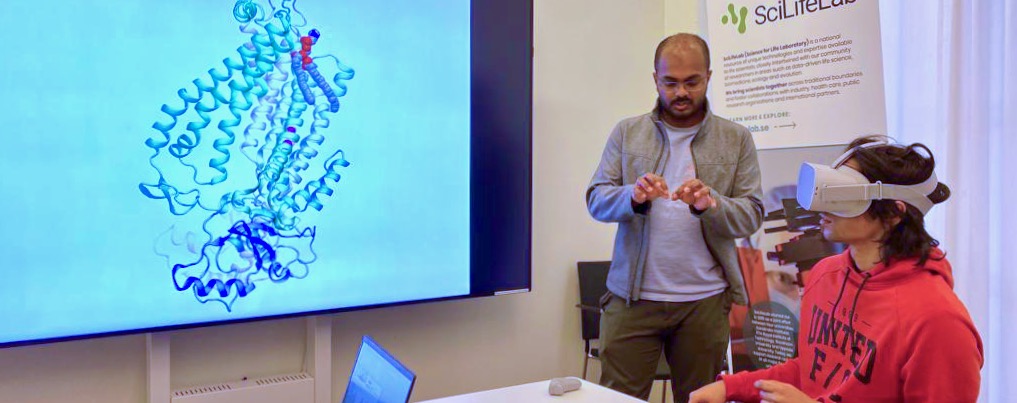
Members of Molecular Biophysics Stockholm joined SciLifeLab colleagues in hosting local high school students for an introduction to life sciences research on 11 March—the first such event possible since the onset of the COVID-19 global pandemic. Among others, Nandan Haloi, Marie Lycksell, and Will Pipatpolkai introduced visiting students to principles of molecular dynamics simulations, including a virtual-reality tour of membrane proteins in motion.