Three remarkable members of Molecular Biophysics Stockholm celebrated completion of their doctoral degrees this spring.
Though their presentations had to be revised to meet public-health recommendations, including video-casting to off-site opponents and committee members, all three delivered polished, informative defenses of their respective theses to enthusiastic remote audiences.
Petter Johansson, Department of Applied Physics, KTH Royal Institute of Technology. Molecular processes in dynamic wetting, 16 April 2020. Opponent: Professor Guillaume Galliero, University of Pau and Pays de l’Adour, France.
Like so many of our colleagues worldwide, Molecular Biophysics Stockholm (MBS) has been engaged in various efforts to navigate and combat the novel coronavirus. Although the group’s past research rarely intersected with virology or clinical work, and none of us are are experts in the field, we hope to help where we can.
Summary by Erik Lindahl, 21-Apr 2020 on Exscalate4CoV and related projects
Members of the GROMACS team and BioExcel Centre also contribute to Exscalate4CoV, a consortium awarded €3 million by the European Commission for research on COVID-19 vaccines, treatment, and diagnostics. Key tasks at MBS include deployment of molecular-dynamics code and free-energy calculations for coronavirus protein simulations and drug-candidate scoring. For an overview of relevant targets, data repositories, and community collaborations, watch Lindahl’s presentation to the Centre Européen de Calcul Atomique et Moléculaire (English, 4:13–36:04).
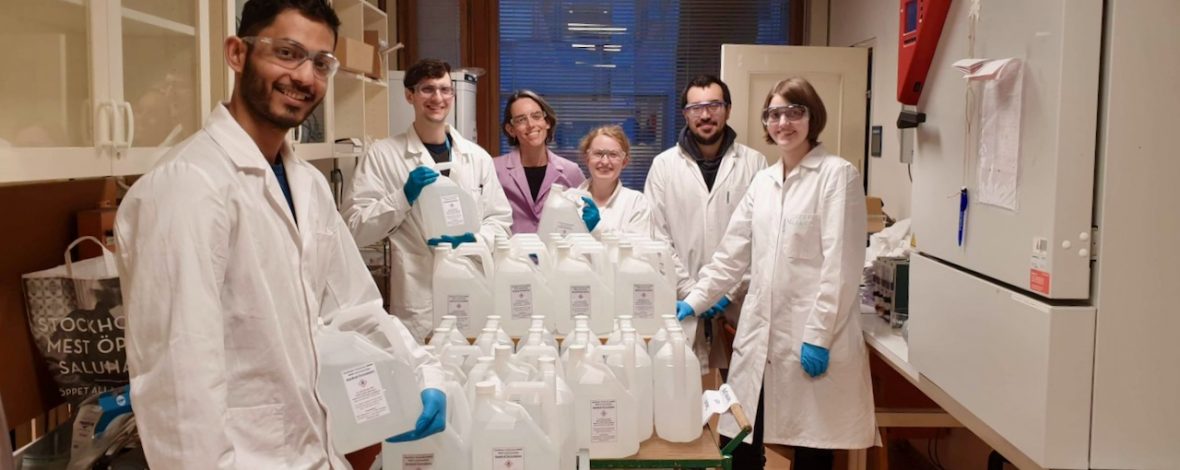
Marie Lycksell and other SU chemists involved in hand-sanitizer production
On the clinical side, members of the Ligand-Gated Ion Channels (LGICs) team have worked with fellow chemists at Stockholm University to alleviate urgent needs for medical supplies, helping coordinate donations of masks, gloves, and other personal protective equipment from SciLifeLab to local hospitals. With reagents contributed by academic groups, the Museum of Natural History, and companies including GE Health, Petrolia, Runa and Absolut Vodka, we also assisted in the department’s production and distribution of over 20,000 liters of hand sanitizer to medical and care facilities. Read more in recent coverage by the university (English) and national (Swedish) media.
Reba Howard producing enzymes for rapid COVID-19 tests
MBS is also involved in an accelerated grant by the KAW Foundation to iLACO-Sweden, a multi-institution project led by Professor Vicent Pelechano (Karolinska Institute) to develop a rapid, low-cost color-based test for COVID-19 infection. The method was recently covered on Sveriges Television, including an interview with LGICs team-lead Reba Howard (Swedish, some English audio).
We are deeply grateful for the dedication and compassion of all MBS members, who continue to find creative paths to productivity even at a distance. Many have managed unprecedented disruptions to academic, research, and development work, including DISstudents Jojo Scott and Phaedra Robinson, whose time abroad was truncated months early by US travel restrictions. We so look forward to collaborating again at higher density on the other side of this pandemic.
Published 1 April 2020 in Acta Crystallographica Section D (v. 76 pp. 350–356):
Development of basic building blocks for cryo-EM: the emcore and emvis software libraries
José Miguel de la Rosa-Trevín, Pedro Alberto Hernández Viga, Joaquín Otónc, Erik Lindahl
Image-processing software has always been an integral part of structure determination by cryogenic electron microscopy (cryo-EM). Recent advances in hardware and software are recognized as one of the key factors in the so-called cryo-EM resolution revolution. Increasing computational power has opened many possibilities to consider more demanding algorithms, which in turn allow more complex biological problems to be tackled. Moreover, data processing has become more accessible to many experimental groups, with computations that used to last for many days at supercomputing facilities now being performed in hours on personal workstations. All of these advances, together with the rapid expansion of the community, continue to pose challenges and new demands on the software-development side. In this article, the development of emcore and emvis, two basic software libraries for image manipulation and data visualization in cryo-EM, is presented. The main goal is to provide basic functionality organized in modular components that other developers can reuse to implement new algorithms or build graphical applications. An additional aim is to showcase the importance of following established practices in software engineering, with the hope that this could be a first step towards a more standardized way of developing and distributing software in the field.
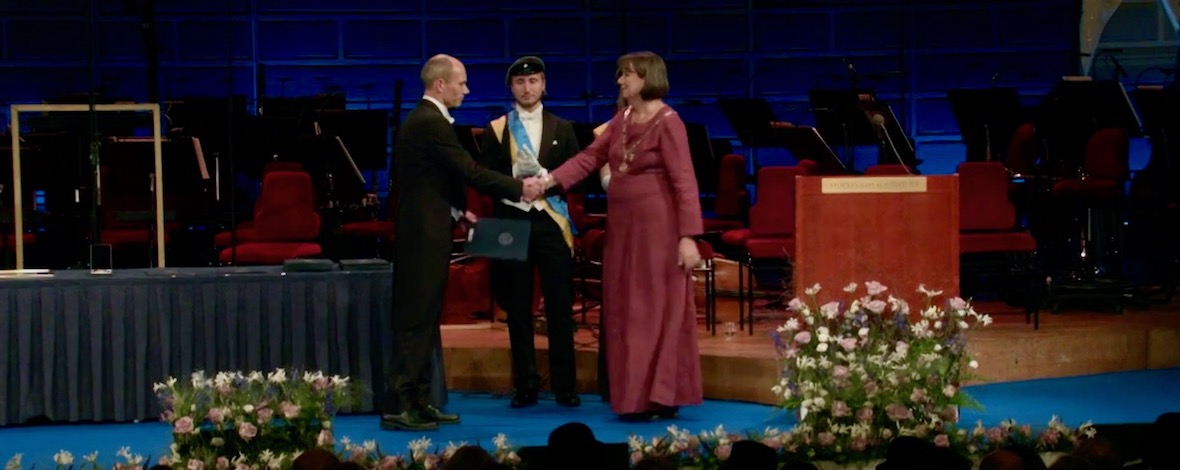
Members of Molecular Biophysics Stockholm celebrated Berk Hess‘ promotion to full Professor in Applied Physics at KTH Royal Institute of Technology, 15 November 2019, conferred by President Sigbritt Karlsson at Konserthuset in Stockholm, Sweden. With funding recently awarded by Vetenskapsrådet to the INTERFACE project, Hess’ team stands poised grow in size and contribution; check back soon for new openings!
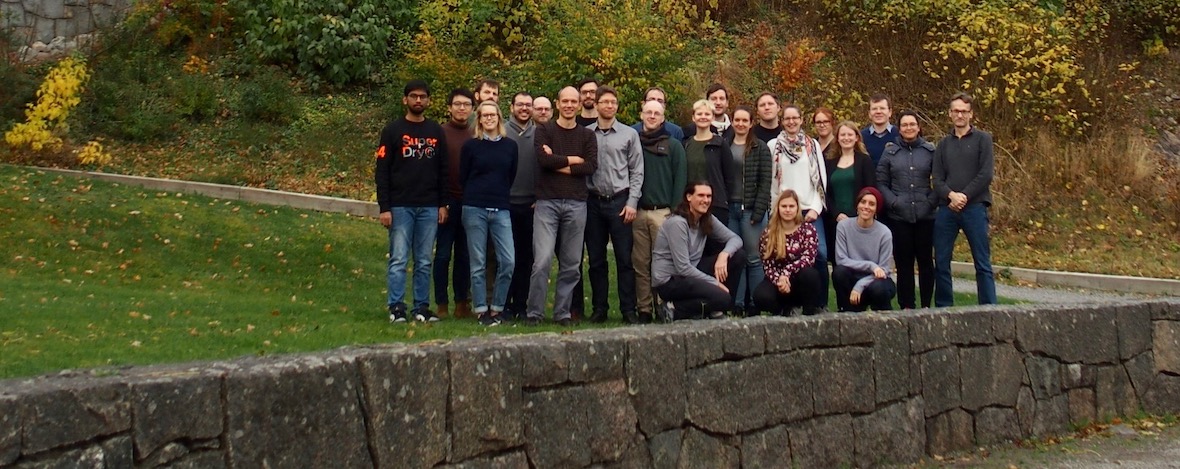
Twenty-three members of Molecular Biophysics Stockholm gathered for our fall off-site retreat, 24–25 October 2019 at historic Vår Gård in Saltsjöbaden, Sweden, workshopping topics related to individual core competencies, academic and industry CVs, group networking, and team communication. Thanks to co-organizers Annie, Joe, Lucie, Reba, and Urška, and to Vår Gård for a beautiful autumn getaway!
Given the need for modern researchers to produce open, reproducible scientific output, the lack of standards and best practices for sharing data and workflows used to produce and analyze molecular dynamics (MD) simulations has become an important issue in the field. There are now multiple well-established packages to perform molecular dynamics simulations, often highly tuned for exploiting specific classes of hardware, each with strong communities surrounding them, but with very limited interoperability/transferability options. Thus, the choice of the software package often dictates the workflow for both simulation production and analysis. The level of detail in documenting the workflows and analysis code varies greatly in published work, hindering reproducibility of the reported results and the ability for other researchers to build on these studies. An increasing number of researchers are motivated to make their data available, but many challenges remain in order to effectively share and reuse simulation data. To discuss these and other issues related to best practices in the field in general, we organized a workshop in November 2018. Here, we present a brief overview of this workshop and topics discussed. We hope this effort will spark further conversation in the MD community to pave the way toward more open, interoperable, and reproducible outputs coming from research studies using MD simulations.
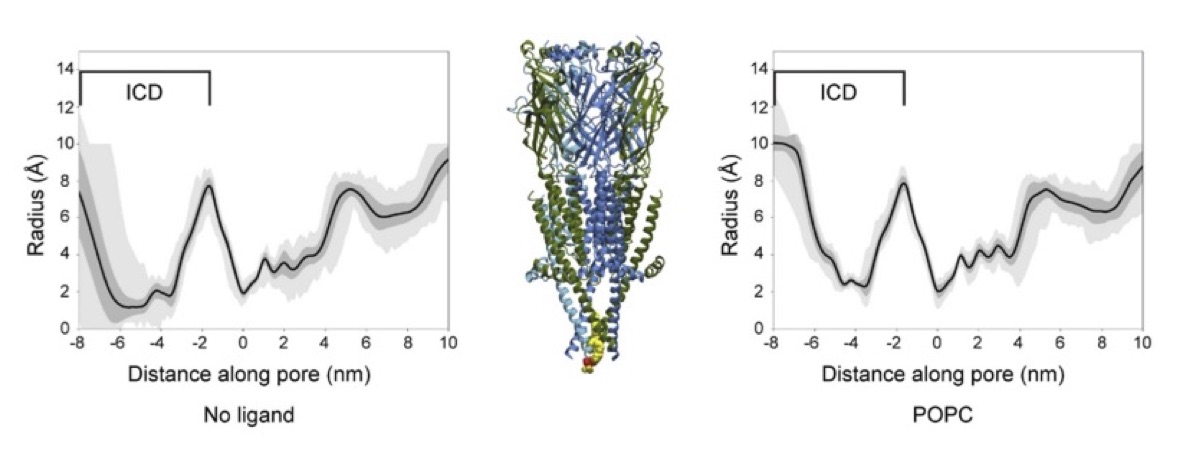
Nicotinic acetylcholine receptors are pentameric ion channels that mediate fast chemical neurotransmission. The α3β4 nicotinic receptor subtype forms the principal relay between the central and peripheral nervous systems in the autonomic ganglia. This receptor is also expressed focally in brain areas that affect reward circuits and addiction. Here, we present structures of the α3β4 nicotinic receptor in lipidic and detergent environments, using functional reconstitution to define lipids appropriate for structural analysis. The structures of the receptor in complex with nicotine, as well as the α3β4-selective ligand AT-1001, complemented by molecular dynamics, suggest principles of agonist selectivity. The structures further reveal much of the architecture of the intracellular domain, where mutagenesis experiments and simulations define residues governing ion conductance.
Four current and former members of Molecular Biophysics Stockholm, along with multiple collaborators, presented their research at the 2019 Jacques Monod Conference Canaux ioniques activés par les ligands: de la structure atomique à la transmission synaptique (Ligand-gated ion channels from atomic structure to synaptic transmission) 24–29 May 2019 in Roscoff, France. Among others, Reba Howard gave an invited talk on Biochemical and simulation studies of allosteric mechanisms in a model Cys-loop receptor.
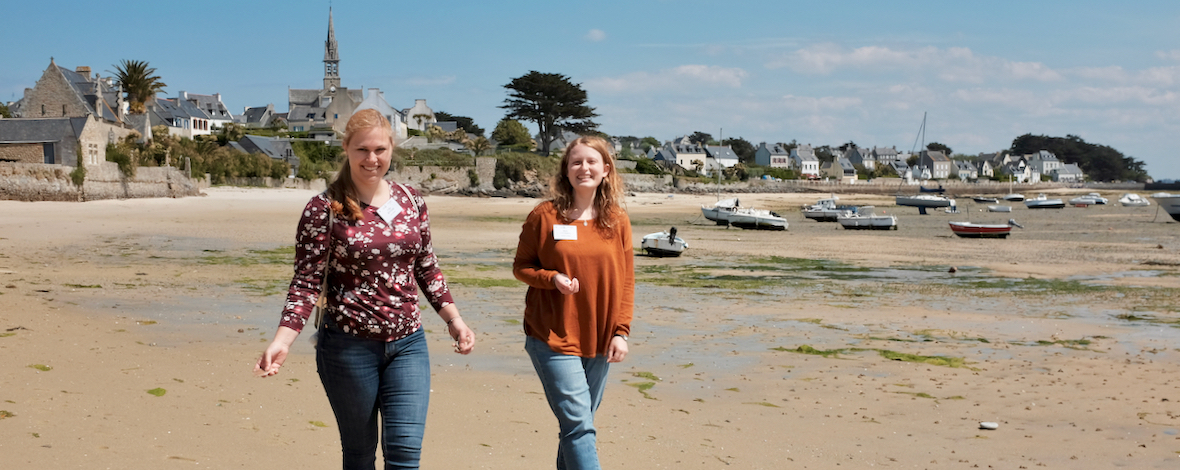
Molecular Biophysics Stockholm again hosted two US undergraduates through the DIS-Study Abroad in ScandinaviaStockholm program in Spring 2019. Under the supervision of Reba Howard and Urška Rovšnik, Sarah Komon (Wheaton College) and Nicole Sanford (St Olaf College) worked ≥20 hours per week on independent projects in the Ligand-Gated Ion Channels team throughout the term, including data collection at both the Science for Life Laboratory and Umeå University. Each presented a research poster at the DIS End-of-Semester Symposium, 7 May 2019 at Stockholm’s Kungliga Musikhögskolan. For an interview with Komon and Sanford regarding their experiences, visit the DIS blog Discover Study Abroad.
Two new DIS students will initiate research projects with the team in Fall 2019. For more information, contact Reba or DIS-Stockholm.
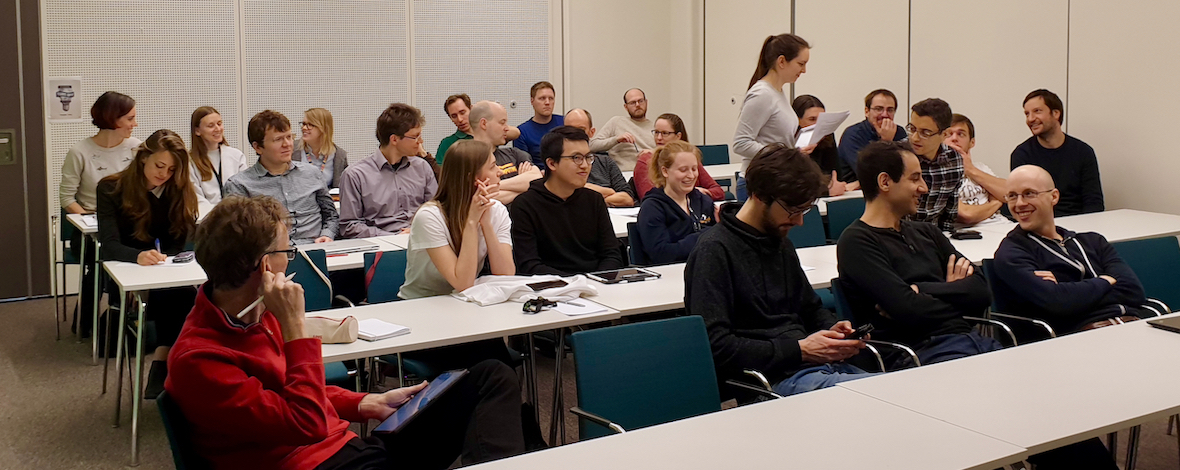
Thirty members of Molecular Biophysics Stockholm, representing thirteen countries and a range of research areas, gathered for a spring mini-retreat on 8 April 2019 at the Science for Life Laboratory in Solna, Sweden. Gabriella Fägerlind of Uppsala’s Implement Diversity AB led a workshop on inclusivity and psychological safety in the academic workplace, followed by small- and large-group exercises around goal-setting and group resource development, and an evening pizza party.